
7 Lessons From Seven Samurai
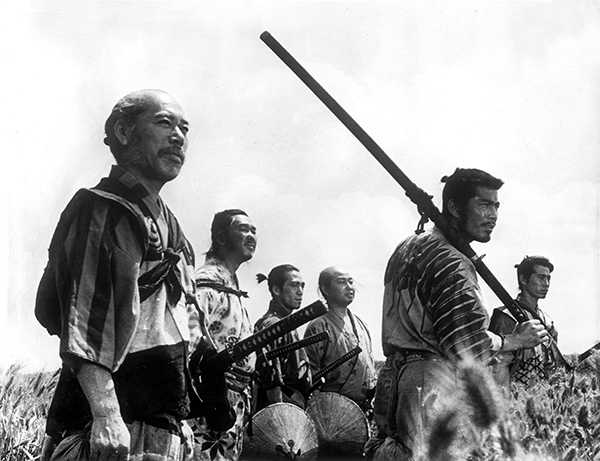
Lead With Humility and Serve Others
The first samurai we meet, Kambei Shimada, will lead the group of samurai defenders and shows what real leadership looks like before he ever picks up a sword. In one of the film’s opening scenes, a child has been kidnapped and taken hostage in a hut. The kidnapper is threatening to kill the child. Instead of going in with guns, I mean swords, a-blazing, Kambei shaves off his topknot — symbol of status and pride for a samurai — to disguise himself as a monk to rescue the child. He didn’t ask anything in return for his services and walked out of the village like a boss.
Throughout the rest of the film, you’ll see him rubbing his head where his topknot used to be. I reckon it was a reminder to him that sometimes to live the Bushido code fully means giving up the outward trappings of prestige.
That moment rescuing the child sets the tone for everything else Kambei does in the story. He leads not by asserting dominance, but by accepting responsibility and serving others. When he recruits the rest of the team, they follow him out of respect for his example, not his rank. He earns their trust through his humility.

Sweat More in Preparation, Bleed Less in Battle
Once Kambei agrees to defend the village, the samurai don’t rush into heroics. They spend most of the film preparing — studying the terrain, training the farmers, fortifying walls, digging moats, and mapping out every approach the bandits might take. The villagers think the samurai are just standing around, but Kambei knows what Sun Tzu wrote centuries earlier: “Victorious warriors win first and then go to war; defeated warriors go to war first and then seek to win.”
When the attack finally comes, the outcome feels inevitable. The bandits charge straight into the traps that the samurai had laid days earlier. Their premeditated preparation beats the enemy’s in-the-moment berserkery.
While we like to think of courage as spontaneous — as a flash of bravery that arises when danger appears — the foundation of bravery is built in advance. The calm you can call up in a crisis will manifest in direct proportion to your readiness to face the challenge.

Be a Quiet Professional
My favorite character in the film is Kyūzō. The guy is a certified badass. He barely speaks throughout the movie, but he communicates through his actions. He’s a master at his craft with the sword. His effort looks effortless (the art of wu wei!). When a boastful samurai challenges him to a duel, Kyūzō wins with a single strike, then walks away without gloating.
We live in an age that rewards noise over skill. Kyūzō teaches us that there’s power in being a quiet professional. Real mastery is self-evident; when you’re truly good at what you do, you no longer have to announce it.
He has the real samurai spirit. He is totally fearless. Yet, at the same time, he is gentle and modest — look how he acted after we went and got that gun. And how he went too — just as though he were going up into the hills to look for mushrooms.
When You Are Strong, I Am Strong
There’s an aphorism in Latin that I love: vales, valeo.
When you are strong, I am strong.
While the seven samurai came from a different culture than the Roman centurions, they embodied this universal principle of teamwork and camaraderie.
The seven samurai come from different backgrounds. Each one has a distinct temperament and personality. One is a war-weary veteran, another a prankster, another a naïve young apprentice. They argue, joke, and occasionally butt heads. But when the bandits attack, they fight as one.
Heihachi, the humble woodchopping samurai, makes a banner for this ragtag group. It consists of six circles and one triangle. The triangle represents their leader, Kambei; the six circles represent the other samurai on the team. It was a symbol of their unity.
You can’t win life’s battles alone. The trick is finding the right men to stand beside you and being the kind of man they can count on.
And what’s interesting is that as you make others strong, you make yourself strong. As Kambei puts it, “By protecting others, you save yourself. If you only think of yourself, you’ll only destroy yourself.”
Vales, valeo.

Honor Is Earned
Kikuchiyo, the film’s comic relief and erratic trickster, is a fraud. He carries a fake samurai pedigree, hiding the fact that he’s the son of lowly farmers — the very people the samurai are hired to protect.
But he desperately wants to be a samurai. He wants to prove himself worthy of honor in a world that says he can’t have it. Kambei sees the unbridled thumos in Kikuchiyo and, instead of rejecting him for not being a true samurai, brings him into his fold to help direct that energy toward something bigger than himself. By the end, Kikuchiyo earns his spurs, so to speak, by living the code of the samurai. He dies defending the village, becoming the samurai he so desperately wanted to be. Rather than letting his past define his life, he creates his legacy through his noble actions.
Keep Your Sense of Humor (Especially Under Strain)
One of the things you’ll notice throughout the film is that even in the most stressful moments, the samurai are laughing. Humor was an important part of maintaining morale.
Heihachi, the woodchopping samurai, is typically the source of that laughter. He isn’t the strongest fighter, but he’s indispensable. When everyone is grim-faced and exhausted, he cracks a joke or hums a tune to boost everyone’s spirits.
When you’re staring down impossible odds, a little levity can save your sanity. Nietzsche famously said that the spirit of gravity, of taking things too seriously, can hobble your ability to act nobly. Strength without levity is fragile and stiff. Humor makes you more flexible. Laughter elevates.

Live for Honor and Purpose, Not for Reward
At the film’s end, though the villagers are safe, four samurai have fallen. Kambei looks at their graves and says quietly, “This is the nature of our trade. We always lose.”
The samurai fought not for glory but for honor. They were tragic heroes. They fought even when they knew they’d inevitably incur casualties.
In a world that measures everything by return on investment, Seven Samurai shows us that some things are worth doing simply because it’s the right thing to do.
You start dying when you stop dreaming.